
Garrick Augustus, April 9, 202
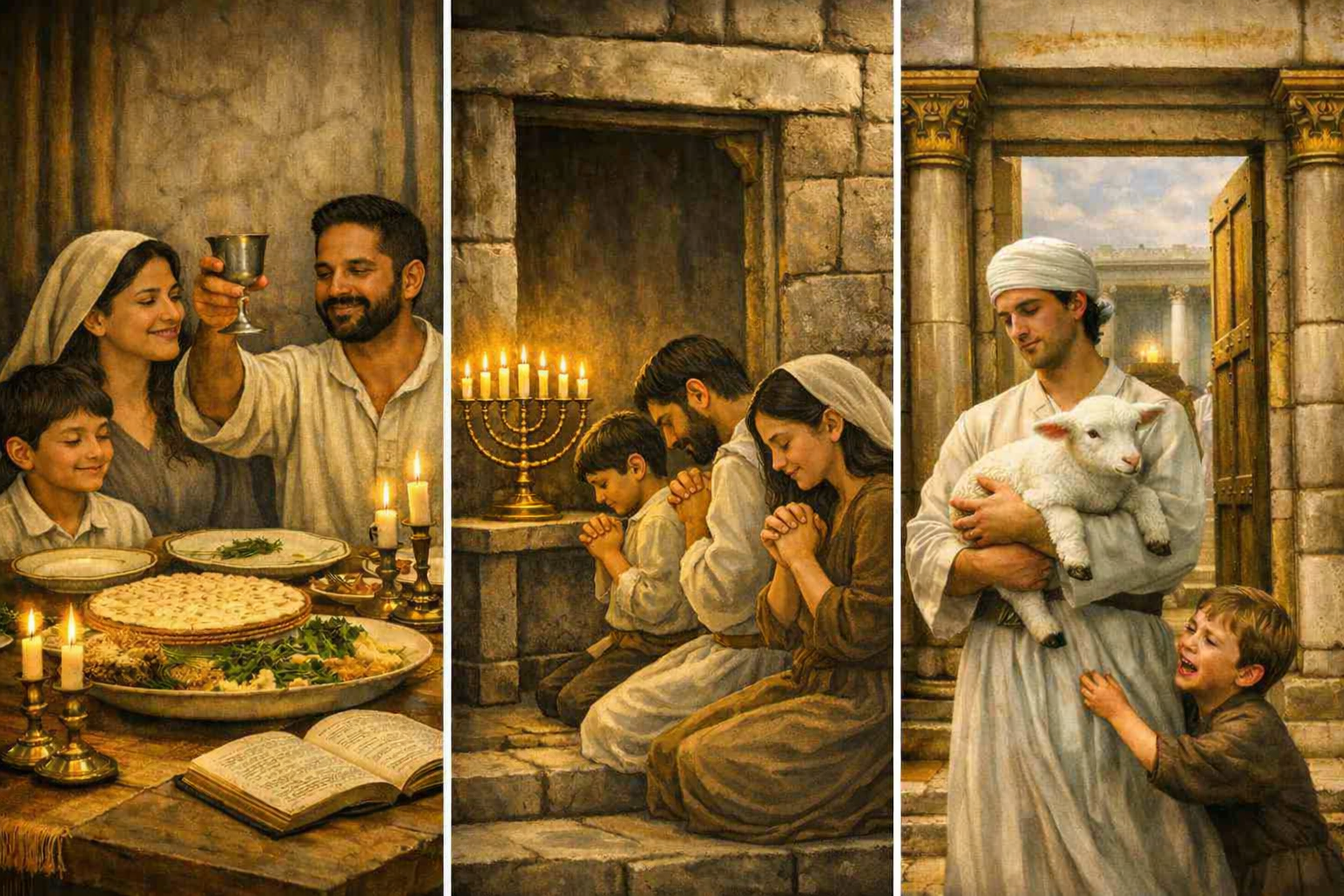
Many Christians do not realize that Passover continued to be observed by the Apostles and their converts after Christ’s crucifixion in 31 AD; instead, they have chosen to participate in the Roman Catholic practice of the Eucharist (Communion). However, Jesus has clearly admonished His followers to “do this in remembrance of Me,”[1] and by ”this,” He meant the Passover. One of the 1888 pioneers left this fact from Church history on record: “The first Christians being mostly Jews, continued to celebrate the Passover in remembrance of the death of Christ, the true Passover; and this was continued among those who from among the Gentiles had turned to Christ… Accordingly the celebration was always on the true Passover day — the fourteenth of the first month. Rome, however, and from her all the West, adopted the day of the sun as the day of this celebration.”[2] In order to faithfully follow this command and keep our body temple pure, that the Lord of Harvest may “pass over us” during His purifying cleansing process, demands a holy preparation to make us whole and cause us to not commit the sin of partaking of the Lord’s table unworthily.
Said the Apostle to the Gentiles, “27Wherefore whosoever shall eat this bread, and drink this cup of the Lord, unworthily, shall be guilty of the body and blood of the Lord. 28But let a man examine himself, and so let him eat of that bread, and drink of that cup. 29For he that eateth and drinketh unworthily, eateth and drinketh damnation to himself, not discerning the Lord’s body. 30For this cause many are weak and sickly among you, and many sleep. 31For if we would judge [examine] ourselves, we should not be judged [condemned]. 32But when we are judged [examined], we are chastened of the Lord, that we should not be condemned with the world.”[3]
A wrong conception of these verses have caused many unlearned Christians to absent themselves from “the Lord’s table,”[4] in fear that they will be slain by Him, because they are not sure how to be acceptable before Him, and as such do not want to “unworthily” make of themselves a shameful spectacle before God, invoking His damnation. Facing such a real dilemma, how then, can we be clean before YHWH and confidently know that we will be accepted of Him at Passover? Let’s explore this question more deeply below.
What Can Make Me Clean before God?
No matter how much we in our own strength attempt to “sanctify ourselves,” by pursuing our own standards of holiness, we shall never be acceptable before the pure and Holy YHWH, for “all our righteousnesses are as filthy rags” in His sight. And long ago, Job also exclaimed, “Who can bring a clean thing out of an unclean? not one.”[5] And the prophet Jeremiah further declared, “O LORD, I know that the way of man is not in himself: it is not in man that walketh to direct his steps.”[6] He knew this to be true because he also declared that “The heart is deceitful above all things, and desperately wicked: who can know it?”[7] Moreover, the Bible teaches that “though thou wash thee with nitre [caustic lye], and take thee much soap, yet thine iniquity is marked before me, saith the Lord GOD.”[8] This is fundamentally true because “there is none that doeth good, no, not one,”[9] and the Wise man reminds us that “there is not a just man upon earth, that doeth good, and sinneth not.”[10] In other words, God knows our frame that we are weak, we are dust, yet He desires to have communion with us, and has provided a mechanism whereby sinful man can be made whole before Him and enter into oneness with his Maker. One songwriter has famously written the words of this song:
What can wash away my sin? Nothing but the blood of Jesus;
What can make me whole again? Nothing but the blood of Jesus
O precious is the flow, That makes me white as snow
No other fount I know, Nothing but the blood of Jesus
The sweet Singer of Bethlehem also petitioned, “23Search me, O God, and know my heart: try me, and know my thoughts: 24And see if there be any wicked way in me, and lead me in the way everlasting.”[11] In this context of preparation, we need to make ourselves available to Him that YHWH will search us through and through—this is what it means to examine ourselves before God. In so doing, we will pursue the following divine counsel that we may bring to pass upon our lives the accompanied blessing: “6Seek ye the LORD while he may be found, call ye upon him while he is near: 7Let the wicked forsake his way, and the unrighteous man his thoughts: and let him return unto the LORD, and he will have mercy upon him; and to our God, for he will abundantly pardon… 13Instead of the thorn shall come up the fir tree, and instead of the brier shall come up the myrtle tree: and it shall be to the LORD for a name, for an everlasting sign that shall not be cut off.”[12]
Gladly, then, shall we realize that all that the Lord requires of us is to do justly, love mercy, and walk humbly before Him, not in our self-righteousness, but in the Righteousness of Christ. God is not asking for great sacrifices of worldly worth, he is not asking for blood to end our lives, instead, He is simply seeking to have His home in our hearts. When we are thus sold out for Jesus, we shall dutifully, on an annual basis, partake of the Lord’s Passover with the blessed assurance that He is honored and “well pleased” to call us brethren, and we will, by no means be heaping damnation upon ourselves!
Let’s learn to pray the prayer of repentance that David prayed as he prostrated himself before the Holy God: “6Behold, thou desirest truth in the inward parts: and in the hidden part thou shalt make me to know wisdom. 7Purge me with hyssop, and I shall be clean: wash me, and I shall be whiter than snow… 9Hide thy face from my sins, and blot out all mine iniquities. 10Create in me a clean heart, O God; and renew a right spirit within me. 11Cast me not away from thy presence; and take not thy holy spirit from me. 12Restore unto me the joy of thy salvation; and uphold me with thy free spirit… 16For thou desirest not sacrifice; else would I give it: thou delightest not in burnt offering. 17The sacrifices of God are a broken spirit: a broken and a contrite heart, O God, thou wilt not despise.”[13]
When we are thus broken before God, He will favor us with His blessings and consecrate us for His reasonable service. To wait for the 14th day of the 1st month to prepare ourselves for the Lord’s Passover is to eat of His table unworthily, and to heap damnation upon ourselves.
“9Wherewithal shall a young man cleanse his way? by taking heed thereto according to thy word. 10With my whole heart have I sought thee: O let me not wander from thy commandments. 11Thy word have I hid in mine heart, that I might not sin against thee.”[14]
While we cannot “cleanse ourselves” in the strictest sense of the word, we must come “broken” before God, and he will do the work of cleansing to make us whole. It begins with an attitude of accepting that we are wretched sinners who have violated God’s laws and need His love, forgiveness, grace, mercy, and truth. We must all get to the place where we will with Paul say, it is not I but Christ who worketh in me both to will and to do of his good pleasure. When God works He finishes all His work with His familiar signature expression, as used at the creation (and will also extend to his new Creation), “and God saw that it was good.”[15] This state of God’s seeing His creation as being “good” or “very good” is a statement of His perfection that has been wrought in us. That’s His nature, and He wants to perfect His redemptive work in us for His own good pleasure.
How Did God Instruct the Ancient Church to Prepare for Passover?
The practice of identifying the Lamb of God and choosing Him has been etched in the ancient ritual ceremonies that led up to the actual Passover feast. Fully “six days before the Passover”[16] the unblemished lamb was chosen out of the fold and befriended by each family member, illustrating the need for each of us to choose Christ, the Lamb of God, who takes away the sins of the world.[17] This same Lamb, is the one whose blood cleanses us from all our sins and iniquities—He washes us to be whiter than snow. Having thus become “friends of the Lamb,” we can with confidence partake of His Table to His honor, glory, and praise. This was the instruction given the ancient church and it is the Lord’s watchword to us today:
“3Speak ye unto all the congregation of Israel, saying, In the tenth day of this month they shall take to them every man a lamb, according to the house of their fathers, a lamb for an house:.. 5Your lamb shall be without blemish, a male of the first year: ye shall take it out from the sheep, or from the goats: 6And ye shall keep it up until the fourteenth day of the same month: and the whole assembly of the congregation of Israel shall kill it in the evening.”[18]
The mention of “six days” may strike you as odd, but Passover is eaten on the 15th day of the 1st month, therefore from the day the lamb was chosen (the 10th), and kept to the 15th, there are 6 full days. And in fulfillment of this type, Mary Magdalene, proverbial for her sins, courageously came forth, behind the brokenness of her tears, and laid hold on the Lamb of God, her sin-pardoning Redeemer, and so ought we today. Those “six days” are left on record for us to realize that for six thousand years, the work of redemption and perfection must be wrought in us that we may become an unleavened lump before our Him. It was not only Christ’s body that is emblematized by the unleavened bread, but our lives too, must be an unleavened (sinless) loaf of grace to His highest honor, glory, and praise.[19]
Some present-truth believers have mistakenly held to the notion that Passover has been abolished by Christ at the Cross, while others hold that if we, today, partake of the Passover before the last parting of the way supper at Ezekiel 9, we will be receiving the Lord’s Table unworthily, and thus bring damnation upon ourselves. They see this principle as a New Testament concept only, which was unknown to the Hebrew Church form Moses to Christ. But this is an erroneous concept that makes Satan happy to see Christians disregard a solemn rite that causes us to contemplate the cost of the Cross. However, long before the birth of the Corinthian Church, God had provided clear Passover preparation guidance to Moses for Israel to follow: “43 And the LORD said unto Moses and Aaron, This is the ordinance of the Passover: There shall no stranger eat thereof: 44 But every man’s servant that is bought for money, when thou hast circumcised him, then shall he eat thereof… 48 for no uncircumcised person shall eat thereof… 49 One law shall be to him that is homeborn, and unto the stranger that sojourneth among you.”[20]
The “circumcision” of our heart is the one being emphasized here, though it by no means negates the duty that all male Christians today shall be circumcised, in obedience to Christ! In the Bible, the circumcision of the foreskin was performed on males only, but the circumcision of the heart is for all. And the Spirit of Prophecy through Ezekiel, preaching of reasons why the Old Testament Church was taken into exile, announced to the rebellious house of Israel, “6 …Thus saith the Lord GOD; O ye house of Israel, let it suffice you of all your abominations, 7In that ye have brought into my sanctuary strangers, uncircumcised in heart, and uncircumcised in flesh, to be in my sanctuary, to pollute it, even my house, when ye offer my bread, the fat and the blood, and they have broken my covenant because of all your abominations.”[21] It is not hard to see that from the earliest times, the “heart” was at the center of the reason for being circumcised, for it carries the understanding of being converted to Christ.
To this end, the Bible further admonishes us, “O Judah, keep thy solemn feasts, perform thy vows: for the wicked shall no more pass through thee; he is utterly cut off.”[22] This same class of “wicked” are further categorized by Isaiah as the uncircumcised, thus he declared, “Awake, awake; put on thy strength, O Zion; put on thy beautiful garments, O Jerusalem, the holy city: for henceforth there shall no more come into thee the uncircumcised [unconverted] and the unclean.”[23]
The phrase “there shall no more come into thee,” and “shall no more pass through thee,” both being identical, establishes the truth that God is addressing the church, Judah (Zion, Jerusalem) in her current polluted state, with a looking forward to the time when she shall no longer be polluted. Those who have discovered and “put on” Christ’s beautiful Garments of righteousness, are today admonished to “keep the feast” as a solemn duty before God.
“This particular prophecy discloses that while the church, Jerusalem and Zion, is asleep and naked with the unclean in her midst, and in captivity among the Gentiles (away from her own land), an awakening cry, a message, comes urging her to arise and put on her beautiful garments, for the wicked, declares the cry, will no more come into her, for they are to be utterly cut off.”[24]
Let the reader note with care that it is “while the church… is asleep…and… away from her own land,” that the divine command is issued to “keep they solemn feasts.” Therefore, in order to keep the feast and not heap damnation to ourselves, we must, as a people, be clothed upon with the spotless Righteousness of Christ. Hence, “Just a firm outward faith in the message is not enough; its inward work in our lives is the all-essential and supreme work that must take place in the lives of all of us before we can conscientiously and profitably celebrate the Lord’s supper. Let us hasten that glad day.”[25]
Although we are encouraged to “hasten that glad day,” there are some who consistently advocate (by their erroneous conclusions), for postponing its arrival—delay that glad day—arguing that we are unprepared now, and will only be ready after the separation described in Ezekiel 9. Sadly, such ones, by their own admission are already judging themselves to be unsanctified and thus “not ready to meet their King.”[26] Let us not squander our time with head knowledge and no heart surrender to our God and Saviour, Jesus Christ, but let us “press toward the mark for the prize of the high calling of God in Christ Jesus.”[27]
As there is a wide difference between a hearer of the word and a doer thereof, so too there is a vast difference between knowing the Truth and living its precepts in our daily lives. And to His faithful followers throughout the ages, Christ has left these parting words, “If ye know these things, happy are ye if ye do them.”[28]
[1] Luke 22: 19, NKJV
[2] AT Jones, 1891, “The Two Republics” beginning on page 95; SDA – A T Jones – The Two Republics : Free Download, Borrow, and Streaming : Internet Archive
[3] 1 Corinthians 11: 27-32, [added]
[4] 1 Corinthians 10: 21
[5] Job 14: 4
[6] Jeremiah 10: 23
[7] Jeremiah 17: 9
[8] Jeremiah 2: 22, [added].
[9] Psalms 14: 3
[10] Ecclesiastes 7: 20
[11] Psalms 139: 23, 24
[12] Isaiah 55: 6, 7, 13
[13] Psalms 51: 6-17
[14] Psalms 119: 9-11
[15] Genesis 1: 18
[16] John 12: 1
[17] John 1: 29
[18] Exodus 12: 3, 5, 6
[19] See 1 Corinthians 5: 7
[20] Exodus 12: 43, 44, 48, 49
[21] Ezekiel 44: 6, 7
[22] Nahum 1: 15
[23] Isaiah 52:1; [added]
[24] V.T. Houteff, 1949, Timely Greetings, Vol. 2, No. 44, p. 43.3
[25] V.T. Houteff, 1944, The Answerer, Book 5, p. 40.2
[26] Ibid, p. 40.1
[27] Philippians 3: 14
[28] John 13:17

 The Adventist's Understanding of Prophecy